Imposter Game Generator
📱 Play on This Device
Pass the phone around the table. Best for playing in person.
🌐 Play Online with Friends
Everyone joins from their own phone with a link. Create a room and share the link or code.
Play OnlineSettings
Pass the device to
Player
YOU ARE A CIVILIAN
It's Player's turn
Say one word out loud that relates to the secret word, then type it below.
Discuss 🗣️
Talk it out. Who sounded unsure? Who copied someone else's clue?
Pass the device to
Player
Secretly choose who you think the Imposter is.
CAUGHT! 🎯
Use this imposter game generator on a single device (phone, laptop, computer or tablet). Add your players, pick a word category and pass the device around. Everyone but the Imposter gets the secret word, and the Imposter has to talk their way through the clues.
What is the imposter game?
The imposter game is a hidden-role party game built on deduction and bluffing. Everyone is told a secret word except the Imposter (some games have more than one), and the group has to work out who was left out.
Players take turns giving one-word clues. Civilians signal that they know the word without naming it, while the Imposter listens for hints and tries to fit in. If you enjoy hidden-role games such as Mafia or Werewolf, this will feel familiar. It is a secret-word bluffing game and a party word game in one. Fans of spot-the-liar games will feel at home, and anyone who has ever wondered “who is the imposter?” knows the thrill.
How does it work?
The game picks a random word, secretly assigns one or more Imposters, and then the group alternates between clues, discussion and a vote until the Imposter is caught or wins. A good generator handles those hidden parts for you, so nobody needs paper slips or a printed deck. In a sentence: the whole table knows the word except the Imposter, who has to fake it and can still win by guessing it.
What makes this imposter game generator different?
Instead of only showing a word and a role, this tool runs the whole game: roles, turns, timers, votes and a scoreboard. These features set it apart:
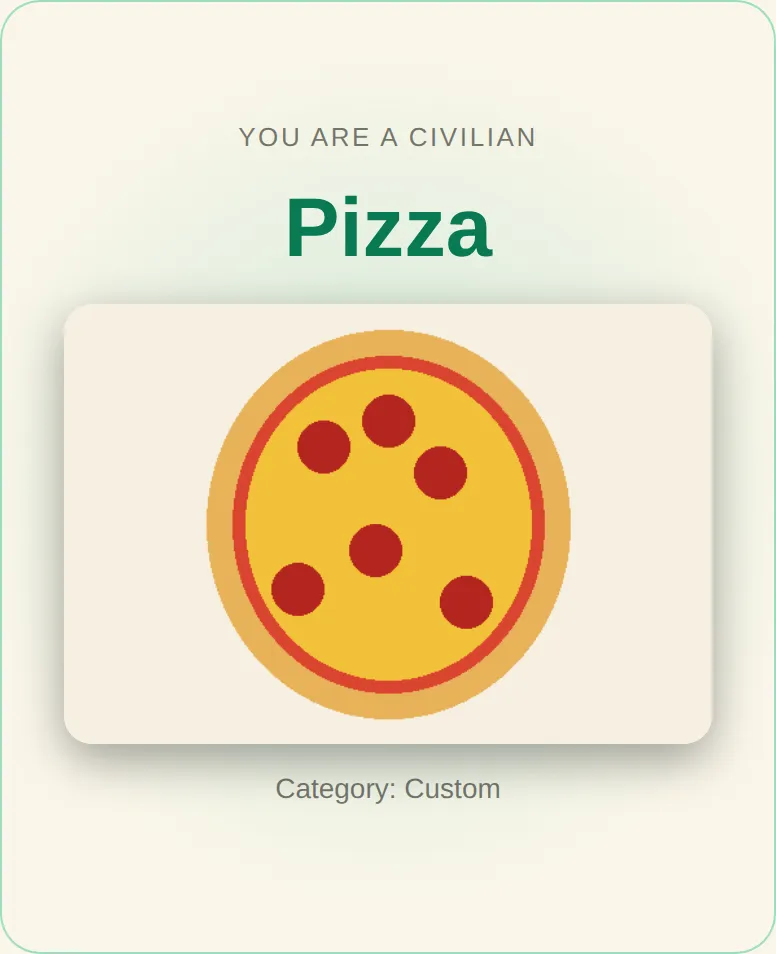
- Pictures of the word. When Show pictures is on, civilians see a photo of the secret word from Wikipedia on their role card. This helps younger players and language learners, and it makes unusual words easier to picture.
- Sneaky mode. The Imposter can receive a similar decoy word and believe they are a civilian, which makes clues much harder to judge.
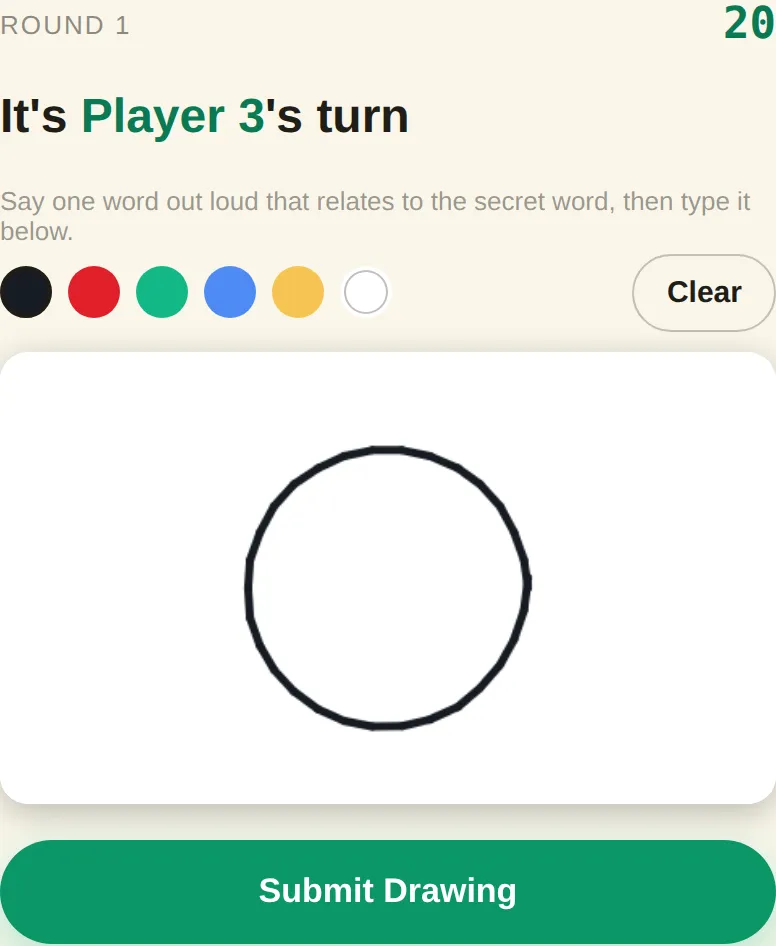
- Drawing clues. Players can sketch a clue on a small canvas instead of typing.
- Mr. Blank. An extra player gets no word at all and has to bluff alongside the Imposter.
- Fair, random picks. Think of it as a built-in randomizer: it shuffles both the words and the players, so nobody can steer who becomes the Imposter.
- Two ways to play. Use one shared device, or let everyone join from their own phone in an online room.
- Points that stay hidden. Scores appear only when a game ends, so the scoreboard never gives the Imposter away.
- Nothing to install. It runs in a mobile-friendly browser tab, with no signup.
Features and settings explained
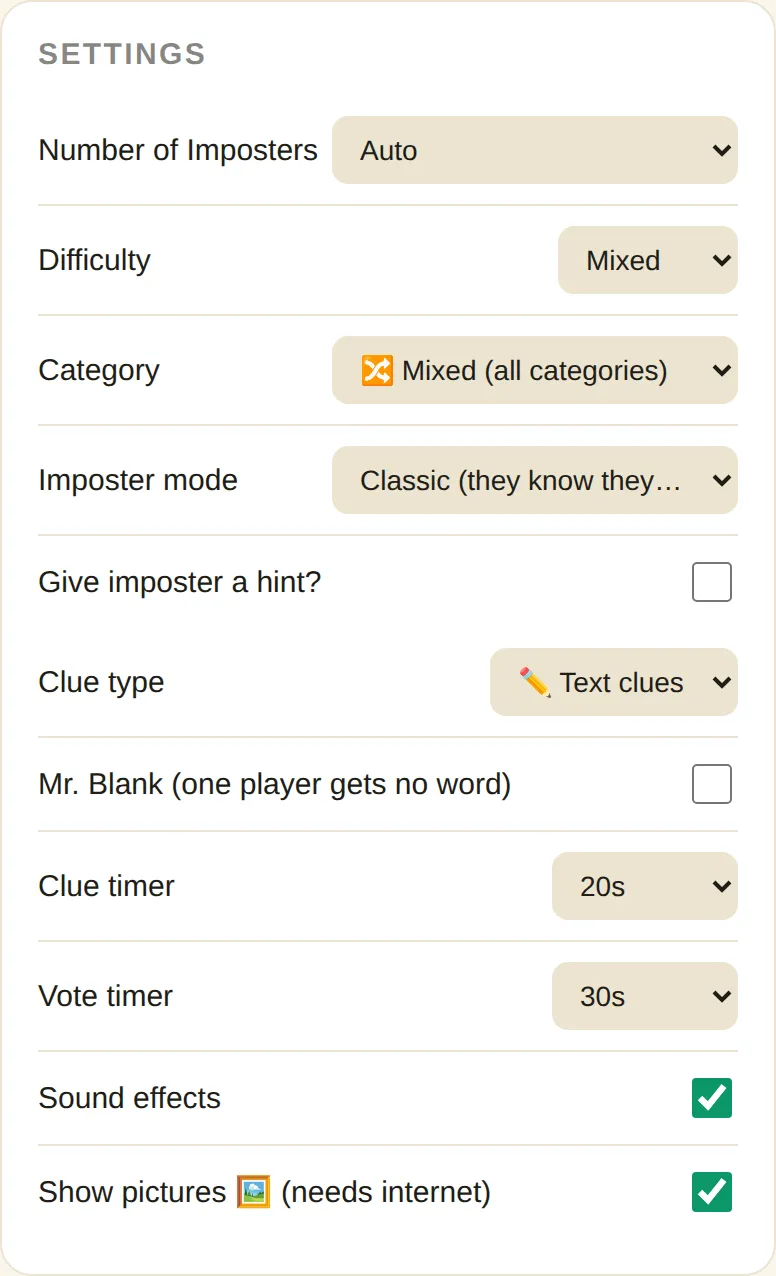
Every game in this imposter generator starts from one settings panel, so you can build your own round in a few taps.
- Players
- 3 to 50 players on one device, each with an editable name and an avatar.
- Number of Imposters
- Auto, any number from 1 to 6, or Chaos, which picks 1 to 3 at random. The count is always kept below half the group.
- Difficulty
- Mixed, Easy, Medium or Hard words.
- Category
- 17 word packs, a Mixed option, or your own Custom Words.
- Imposter mode
- Classic, where the Imposter knows their role, or Sneaky, where they get a decoy word.
- Hint for the Imposter
- In Classic mode you can switch on a short, indirect hint, such as “Sandy, salty, and usually crowded in July” for the word Beach.
- Clue type
- Text clues (up to 40 characters) or drawings.
- Timers
- A clue timer (15, 20 or 30 seconds) and a vote timer (20, 30 or 45 seconds), or untimed play. When time runs out, the clue is skipped or a random vote is cast.
- Sound and pictures
- Sound effects and word pictures can each be switched off.
How to play the imposter game step by step
These instructions cover every mode.
How to set up a round on one device
- Add players. Use the + and − buttons, then rename anyone you like.
- Choose your settings. Pick a category, difficulty and number of Imposters, then press Start Game.
Playing a round
- Reveal roles in secret. A pass screen names the next player. They tap to see their role and word, then hide it before passing the device on.
- Give clues in turn. Each player says one word that relates to the secret word, then types or draws it.
- Discuss. Compare the clues. Who sounded unsure, or copied someone else?
- Vote in secret. The device is passed around again for private votes. The player with the most votes is out.
How to play in real life
Sit around a table and keep the screen out of sight while roles are revealed. Spoken clues work well, as long as everyone says only one word. If you prefer drawing, switch the clue type to Drawings.
Imposter game rules and instructions
- Civilians win when every Imposter has been voted out.
- Imposters win when they equal or outnumber the remaining civilians, or when an Imposter correctly guesses the secret word on their own turn.
- A wrong guess costs nothing, so the Imposter can try again on a later turn.
- A tie eliminates nobody, and the Imposters survive that vote.
- Eliminated players sit out later rounds.
- After a vote you can give another clue round, vote again, or reveal the Imposter and end the game.
Example round: five friends and one Imposter
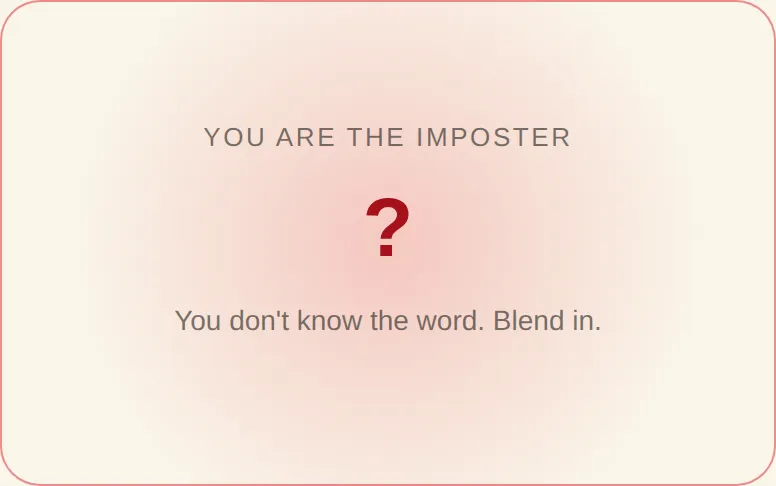
Five friends choose the Food & Drink category on Medium difficulty, and the secret word turns out to be Ramen. Maya is the Imposter, so her role card shows a question mark instead of the word.
The first player says “broth” and the second says “noodles”. Maya, who has only heard those two clues, answers “warm”. It is safe, but it is also vaguer than everything else on the board. During the discussion, the group notices and votes.
Three civilians vote for Maya and the fourth votes for someone else. Maya is eliminated, the civilians win, and the scoreboard gives 2 points to each civilian who voted for her, 1 point to the civilian who didn’t, and 0 to Maya. The lesson for any Imposter: a clue that is too careful is a clue that gets noticed.
How does scoring work?
Players earn points for good detective work or good bluffing, and the totals are added up across every round of a game. The scoreboard appears only once the game is over, so seeing who scored never gives away who the Imposter is.
| What happened | Points |
|---|---|
| An Imposter is voted out | Civilians who voted for an Imposter get 2, other civilians get 1, Imposters get 0 |
| An innocent player is voted out | Imposters who voted get 2, civilians who voted for an Imposter get 1, other civilians get 0 |
| A vote ends in a tie | Each Imposter gets 2 |
| The Imposter guesses the word | Each Imposter gets 2 |
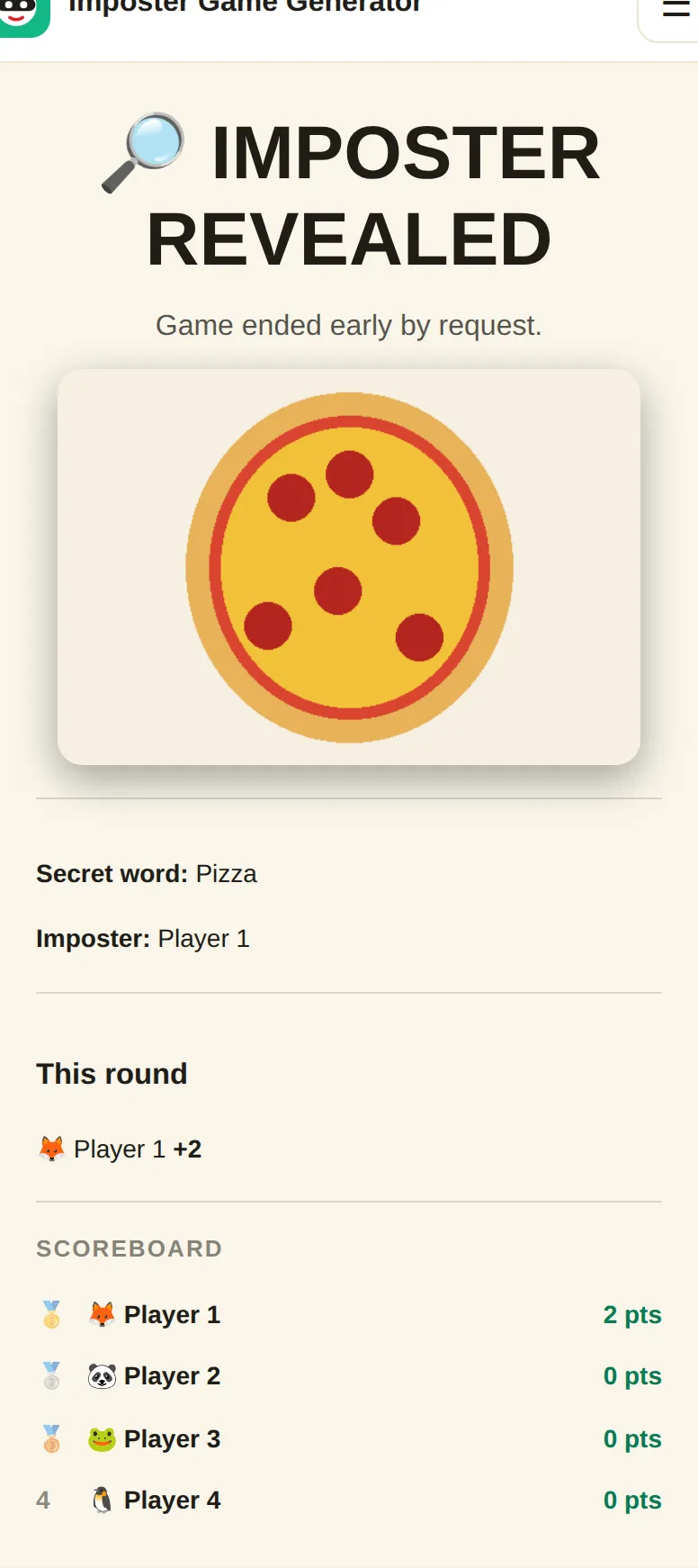
| The host reveals the Imposter early | An unfinished round counts as a tie, so Imposters get 2 |
Choose Next Game (Keep Score) to carry totals into a new game, or New Game to reset everything.
How many players do you need?
You need at least three players, and up to 50 can share one device.
Playing with 3 people
It works, but one wrong vote ends the game quickly, so keep it to a single Imposter.
Playing with 5 people
Five players is the sweet spot for a first game: there is enough chatter to hide in, and every vote matters.
Bigger groups
On Auto, a group of about nine gets two Imposters. Larger groups can use 2 or 3 to keep every vote tense.
Categories and word ideas
The generator draws on 17 categories, from Everyday and Animals to Video Games, at Easy, Medium or Hard difficulty, and it never repeats a word until the whole pool has been used. Want to preview them? Our word guide lists every word with its hint, including good words for game night, hard words and funny imposter words. Prefer your own? Choose Custom Words and build a round from your own list.
Hints, Sneaky mode and Mr. Blank
A game with hints is easier for newcomers, and these three options change how hard the Imposter’s job feels.
- Hint: in Classic mode, the Imposter sees a short clue about the word. It never repeats the word itself.
- Sneaky: the Imposter sees a similar word from the same category and thinks they are a civilian. They can’t use the guess box, because they don’t know their role.
- Mr. Blank: one non-Imposter gets “???” instead of a word and has to bluff. They count as a civilian when the winner is decided.
If you know Mr White from the Undercover game, Sneaky mode is the Undercover-style twist and Mr. Blank is the Mr White-style role. Other spy word game variants use the same idea of a player who doesn’t quite know the word.
Ideas for parties, families and classrooms
Imposter party word game for big groups
The party edition is simply a bigger group: with up to 50 players, set 2 or 3 Imposters and keep the clue timer on so the turns move quickly.
Imposter family game
Choose Animals, Everyday or School words and switch on pictures for younger players. Unlike imposter card games that need a printed deck, this one runs on a screen you already own.
Classrooms and clubs
Teachers and club leaders can use Custom Words as a vocabulary warm-up or an icebreaker, since each player has to describe a term without naming it.
Discussion questions that catch the Imposter
Whichever mode of this imposter game generator you choose, the discussion phase is where most games are decided. Ask about the clues, never about the word itself, so the Imposter learns nothing new.
- “Which earlier clue is closest to yours, and why?”
- “Would you have given the same clue if you had gone first?”
- “Who gave the clue you almost chose?”
- “Which clue felt too careful to you?”
Some groups call this an imposter questions game, because the questions matter as much as the clues. A real civilian answers quickly and specifically. An Imposter tends to hedge.
Common mistakes to avoid
- Giving a clue so obvious that the Imposter can copy it.
- Accusing someone before the first clue round is over.
- Leaving the screen visible while passing the device.
- Choosing Hard words for a group that is brand new to the game.
Tips for winning as a civilian or an Imposter
- Civilians: choose a clue that only someone who knows the word would pick, then stop before it points straight at it.
- Imposters: listen to the first clues for the category, then choose a word that fits many answers.
- Everyone: watch for clues that copy the previous player, and for players who hesitate.
- Groups new to the game: start with Easy words and a 30-second timer.
Playing with friends in other places
If your group isn’t in the same room, you don’t need to share a screen. The online version gives each player a private role card on their own device.
Frequently asked questions
Is it free to play?
Yes. It is free to play in any browser, with no account, no app and no download.
Is there an unblocked version for school or work?
It runs in a normal browser tab with no install, but whether it opens depends on your network’s filters. Online rooms and word pictures need an internet connection, while pass-and-play can keep working offline once the page has loaded.
Is there a 2 player mode?
No. The tool needs at least three players, because two people can’t hide a role, hold a discussion and vote in a meaningful way.
How does the imposter picker choose the Imposter?
The page shuffles the player list at random for each game and takes the first names as Imposters. Nobody, including the person holding the device, can choose or predict the result.
Is this an imposter questions game?
No. Players give one-word clues, typed or drawn, rather than answering a shared question. If your group likes questions, use the discussion phase to ask follow-ups about each clue.
How long does a game take?
With the 20-second clue timer on, five players spend under two minutes on clues. Discussion has no time limit unless your group sets one, and the vote timer is optional.
Do the word pictures need internet?
Yes. Pictures are fetched from Wikipedia when a game starts. If you’re offline, or no good match exists, the game skips the picture. You can also switch Show pictures off.
What does the page save in my browser?
Only a short list of recently used words, so the same word doesn’t return too soon. Player names and results aren’t stored.
Ready for a round?
Scroll up and start a game, or play online with friends. More guides are on the way in the blog.